

HVAC · PLUMBING · SINCE 1981
Gas Line Repair and Installation in Sacramento, CA

Gas line work sits in a different risk category than the rest of plumbing, and it is the one area where cutting corners has consequences that are not recoverable. American Energy Home Pros installs and repairs natural gas and propane piping across the greater Sacramento area, and our licensed technicians (License #1083187) pressure test and permit the work. We are open 24 hours a day. If you smell gas right now, leave the building and call your utility from outside before you call us.
Work We Perform
- New appliance lines. Running gas to a range, cooktop, dryer, water heater, furnace, fireplace, pool heater, or outdoor kitchen, sized for the appliance’s input rating rather than to whatever pipe happens to be nearby.
- Leak location and repair. Locating leaks at joints, fittings, valves, and buried runs, then repairing to code rather than sealing a symptom.
- Line replacement. Replacing corroded steel, failed fittings, or undersized runs that cannot support the appliances connected to them.
- Generator and BBQ stub outs. Dedicated lines with correct shutoffs and sediment traps.
- Propane systems. Common on foothill and rural properties in Camino, Cool, Applegate, Placerville, and Wilton where natural gas service never reached. Propane operates at different pressure and requires different sizing and regulation.
- Earthquake shutoff valves. Seismic gas shutoff valves, which some jurisdictions require and which are worth considering here regardless.
How We Test for Leaks
- Combustible gas detection. An electronic detector sweeps the run, fittings, valves, and appliance connections to locate the source rather than narrowing by guesswork.
- Pressure testing. The system is isolated and pressurized, then held and monitored on a gauge. A line that holds pressure over the required interval is proven tight, which no amount of visual inspection can establish.
- Bubble solution verification. Individual joints are confirmed with a leak detection solution after the pressure test identifies a section.
- Appliance connection and draft check. We verify manifold pressure at the appliance and confirm proper draft on vented equipment, since an appliance can be gas tight and still unsafe.
- Load calculation. Where appliances are being added, we calculate total connected load and verify the pipe size and meter capacity support it. Undersized piping is a performance and safety issue, and it is a very common finding.
Signs of a Gas Problem
- The distinctive sulfur or rotten egg odor of the odorant added to gas
- A hissing or whistling sound near an appliance, meter, or buried line
- Dead or discolored vegetation in a line along an otherwise healthy lawn
- Bubbling in standing water above a buried gas line
- Appliances that will not stay lit, or burn with a yellow rather than blue flame
- A gas bill that has climbed with no change in usage
- Headache, nausea, or dizziness that improves when you leave the house
- A carbon monoxide detector that has activated
Code and Permitting
Gas piping is governed by the California Plumbing Code and the California Mechanical Code, and the requirements that matter most are sizing for total connected load, appropriate materials for the location including protection of any buried or exposed run, an accessible shutoff at each appliance, sediment traps where required, correct support spacing, and a documented pressure test. Every one of those is verified at inspection, which is why gas work should always be permitted. We pull the permit as part of the job.
Propane adds requirements around regulation and tank distance that differ from natural gas, which is one reason foothill work is not simply a longer version of a valley job.

Smell gas? Leave first.
Leave the building, call your gas utility from outside, then call us for the repair. We answer day and night.
How We Verify the Work
No gas job is complete without a documented pressure test held for the required interval and witnessed at inspection where the jurisdiction requires it. Beyond that we verify manifold pressure at each appliance against its rating, confirm every appliance shutoff is accessible and functional, sweep all new and disturbed joints with an electronic detector, and check draft on vented appliances. You get the test result, not an assurance.
Why Gas Work Is Never a DIY Project
The two failure modes are fire or explosion and carbon monoxide poisoning, and neither gives you a second chance to reconsider. Beyond that, undersized gas piping is a subtler hazard: an appliance starved for gas can burn incompletely and produce carbon monoxide while appearing to work. The Consumer Product Safety Commission’s carbon monoxide center documents how frequently fuel burning appliances are the source.
Unpermitted gas work also follows you. It is a disclosure issue at sale, insurers can deny claims tied to unpermitted work, and the next contractor who touches the system inherits assumptions they cannot verify.
Why Choose American Energy Home Pros
- Established 1981, more than 40 years serving the greater Sacramento area
- California license #1083187, licensed, bonded, and insured
- 5.0 star rating across more than 1,100 Google reviews on our Sacramento, Folsom, and Loomis listings
- Open 24 hours a day for emergencies
- Upfront pricing presented before work begins
- Three locations covering Sacramento, Placer, El Dorado, and Nevada counties
- Financing available, including 0 percent options for qualified customers
- Locally owned, with the owner reachable directly
Schedule Gas Line Service
Tell us what you are adding or what you are smelling. For a suspected leak, get out of the building and call the utility first, then call us. Gas work often accompanies water heater installation and furnace installation, and if you are adding a tankless water heater the gas line is usually the deciding cost, which we cover on that page.
Gas Line FAQs
What do I do if I smell gas?
Leave the building. Do not switch lights on or off, do not use a phone inside, and do not try to find the leak. Call your gas utility from outside. Then call us for the repair.
Do I need a permit to add a gas line?
Yes. New gas piping is permitted and inspected work, and the pressure test is part of that inspection.
Can you run a line for a new range or outdoor kitchen?
Yes. We size the line to the appliance input rating and verify that your existing system and meter can support the added load.
How do you find a leak in a buried line?
Pressure isolation narrows the section, then electronic detection and, where needed, bar hole testing pinpoints it. That keeps excavation to a minimum.
Do you work on propane systems?
Yes. Propane is common on foothill and rural properties and operates at different pressure with different sizing and regulation requirements.
Why does my new appliance underperform on the existing line?
Usually because the pipe is undersized for the total connected load. Adding a high input appliance to a line sized for the old one starves everything on it. We calculate the load before quoting.
What is a sediment trap and do I need one?
It is a short capped drop at the appliance connection that catches debris before it reaches the gas valve. It is required at most appliances and frequently omitted on unpermitted work.
Should I install an earthquake shutoff valve?
Some jurisdictions require them. In this region they are worth considering regardless, since an unsecured or damaged gas connection after a quake is a fire risk.
GET A REAL NUMBER, NOT A RANGE
Tell us what’s going on. We’ll call you back, a real local human, usually within the hour.
No obligation. No pressure. We never sell your information.
ON THIS PAGE
24/7 EMERGENCY
WE ANSWER DAY OR NIGHT
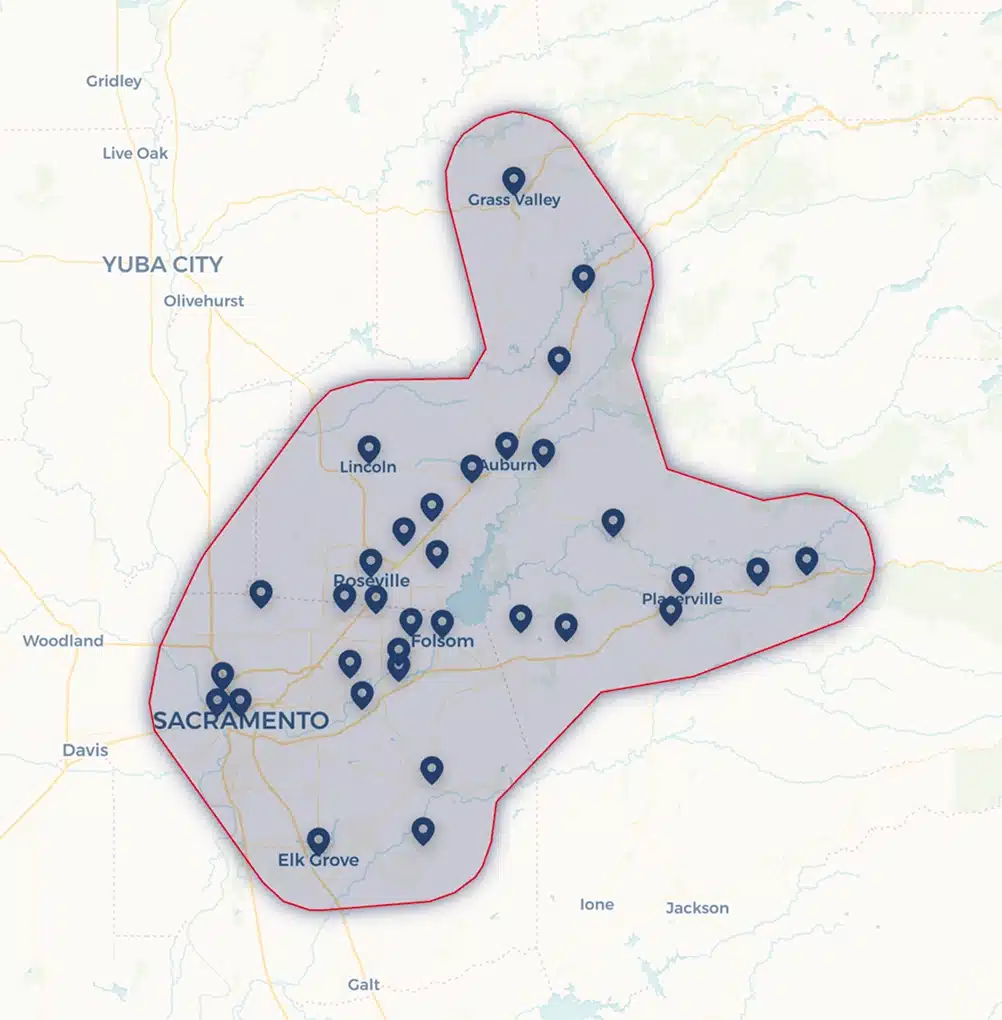
HVAC & plumbing across greater Sacramento.
From Loomis to El Dorado Hills, our team services 35+ communities for both HVAC and plumbing. If you’re in the area, we can be at your door - usually same day.
Communities we serve (HVAC + plumbing):
 1,100+ reviews
Hear what our customers are saying



Carter from American Energy exceeded my expectations for a standard inspection. He left our HVAC system looking bright and shiny! He called before and was able to come by early. Really appreciated that!


Greg Rangel was on time, gave me a courtesy call before he arrived, and once he arrived, he called to find out the issues with the AC and got to work. Greg provided me with information about the AC unit after he found out what was happening, and he walked me through the process and the cost! He also changed the filter! I am now a member due to his outstanding customer service. Thank you, Greg, for your professionalism.
This company responded immediately to address an air conditioning problem for my elderly Mother during 100 degree heat. They responded in just a couple of hours. Greg Rangel was the technician and fixed the problem. He did explain the unit was older and would soon need replacement. He thoroughly explained this to me and offered a senior discount for my Mother and a lower priced unit. Job well done and thank you.
Technician conducted a thorough inspection of the HVAC system while maintaining a friendly and positive demeanor.
I recently had an air duct cleaning and I am very happy with the results. The team was so knowledgeable and personable. I would use them again for this or other HVAC needs.
Quick scheduling and professional service. I will use them again and again. Thank you!!
Great A/C service by Garrett. He was very thorough and knowledgeable on his service. Would highly recommend.
Truly professionals. Garrett showed up at scheduled time, answered all my questions and did a thorough inspection of my unit. Never felt pressured or like I was trying to be sold on anything. He explained everything along the way. An issue was found on some wiring outside, I was shown the issue and given the option to have it fixed. He showed me the completed work and the material used. I would highly recommend this locally owned and operated company.
Greg arrived late Saturday evening and worked out the problem. He explained the problem and eventually determined it began with the original set up of the thermostat, which was wrong for a heat pump. The problem was fixed, and great credit to Greg for being enthusiastic, professional and staying until it was done.
We have had a great experience with everyone from American Energy. Today we had David, and he is a very nice young man, respectful, knowledgeable and very professional. I would recommend this company to all my friends and family.

